
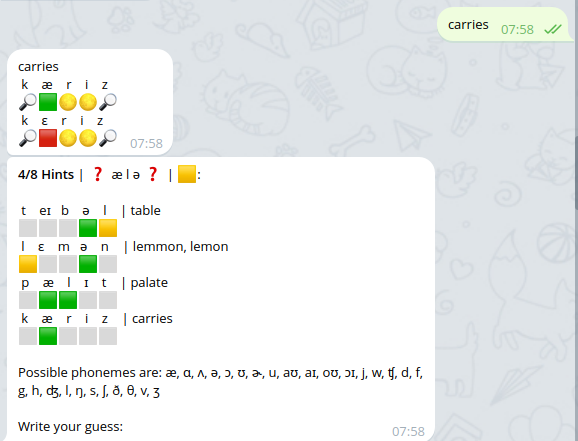
Phonemic Wordle is a Wordle variant I made on Telegram in 2022, @wordle_phonetic_bot. This is a bot for playing a phonemic version of wordle (~IPA, American English) where you are not guessing spelling but phonemes: words with 5 phonemes in American English in particular.
You type guesses in plain English, and the bot shows the CMU Pronouncing Dictionary phonemic transcriptions, converts the guess into phonemes and gives Wordle-style feedback on the sounds.
It is much more chalenging than regular Wordle. The bot gives 8 attempts instead of 6 to compensate for the bigger number of phonemes in comparison to letters. It’s a great tool to learn about English phonemes and pronunciation.
The coolest part of it turned out to be collaborative play. You can add the bot to a Telegram group and let everyone suggest candidate words. I mostly played with one or two more people.
Also, I decided to use mastermind rules so if you write two equal phonemes and there is only one in the target word, you get yellow for both. For a full description, see the bot’s help text:
Bot's help text
Start a phonemic wordle game by sending
/play.
Rules:
- Guess the pronunciation of a word with 5 phonemes using 8 attempts, assuming an American accent.
- Send
/guess anenglishword, written using the Latin alphabet, or use/check yourwordfirst and press the send button. In a private chat,/guessis not needed. The word will be converted to its American pronunciation using a phonemic representation. - If the pronunciation of your guess has a character in the pronunciation of the word you are trying to guess, and in the same position, it will be marked 🟩. If it is in the target word but not in the same position, it will be 🟨, regardless of anything else. If the character is not in the word, it will be ⬜️.
🆒 Playing collaboratively is more fun than playing alone. Create a group with some other person or people and help each other guess the word.
Extra:
- ➕ You can send
/playhardto play a hard version in which the word will contain one unfrequent phoneme, indicated by a question mark in the list of possible phonemes. - ➕ You can add numbers 4 or 6 after
/playor/playhardto play a game where the word has length 4 or 6. For example,/play 4or/playhard 6. - ➕ The check function also helps you see how good your check is with respect to the information you already got. It tells one of six things about a character:
🟩 means you already know it is going to be green.
🟨 means you already know it is going to be yellow.
🔰 means it can be green or yellow.
🟥 means the character is not in the word.
🔎 indicates you are exploring and have no information about this character.
🌕 means the same as above, but you know you are not going to hit green because you already know the green character in this position.
The /check command is also allows you to check the pronunciation of a word even if you are not playing. And also to check it out before committing to it as a guess. If the dictionary has several pronunciations for that spelling, the bot shows them all along with buttons for sending them. During a game, /check also annotates a candidate pronunciation against the information you already have, so you don’t mess up sending things only to discover you already knew the information of a letter in that place.
There is also a hard mode with /playhard, where the answer contains at least one uncommon phoneme, marked with a question mark in the list of possible phonemes, and so the solutions are less common words. The code has word lists for 4-, 5-, and 6-phoneme games: 1000 normal answers of each length, plus hard lists of about 800 words for each length.
I like the challenge that comes from this game, and it helped me to put to good use some phonemic rules I learned about the regularities arising in the spelling to phoneme map of English. English is quite irregular in this aspect, but actually much less than what at least most of us English-as-a-second-language speakers tend to think. More on that on another post.