
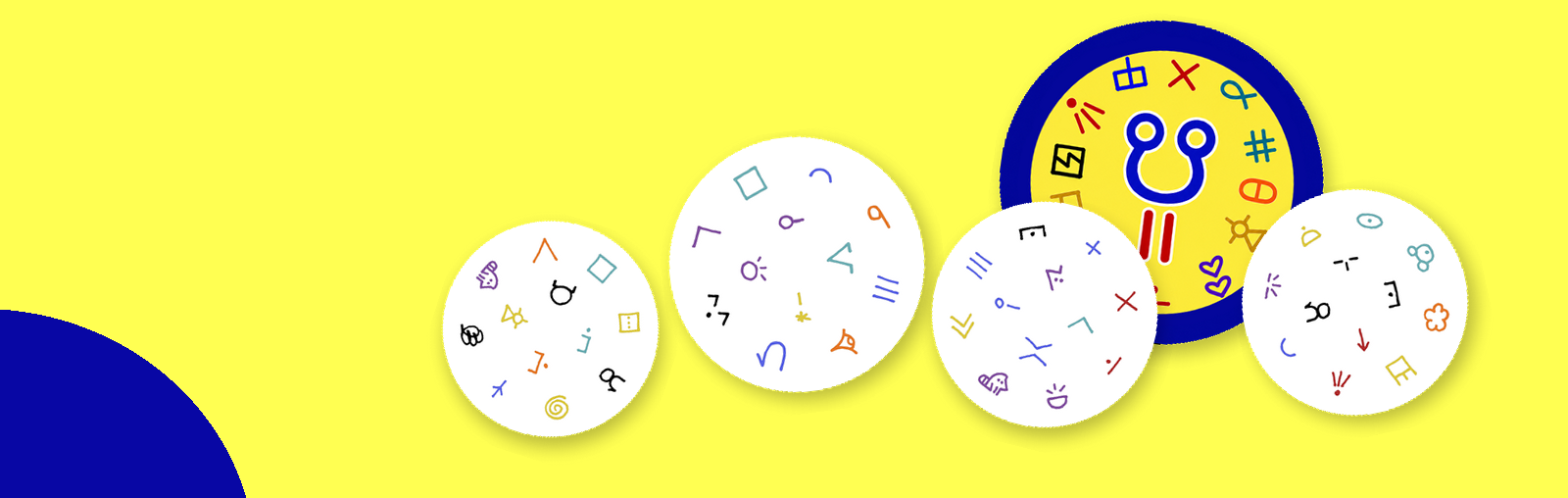
Musi Tu is a version of Spot It / Dobble I made in 2025 along with friends, that uses Toki Pona glyphs: every pair of cards has exactly one symbol in common, and the game is to find that shared symbol before everyone else.
Can you find the matches between the cards on the images?
It’s a nice game, whether you know about Toki Pona or not. We played it in my city with people who did not know sitelen pona, or who were only starting to learn it, and they loved it. If you do not know the word, you just point at the symbol. If you want to learn and play with someone who knows, try to say the word and if you don’t know it, others will remind you. When I played it, after a few rounds, a few people learned the name of quite a few glyphs.
You can print and play this version, or get it printed and cut through The Game Crafter. I added 0 markup, so it is as cheap as The Game Crafter allows. The printed version contains 67 of the 133 possible cards, with the other 66 cards available separately so the decks can stay affordable and separable.
This is how the print-and-play version looks:
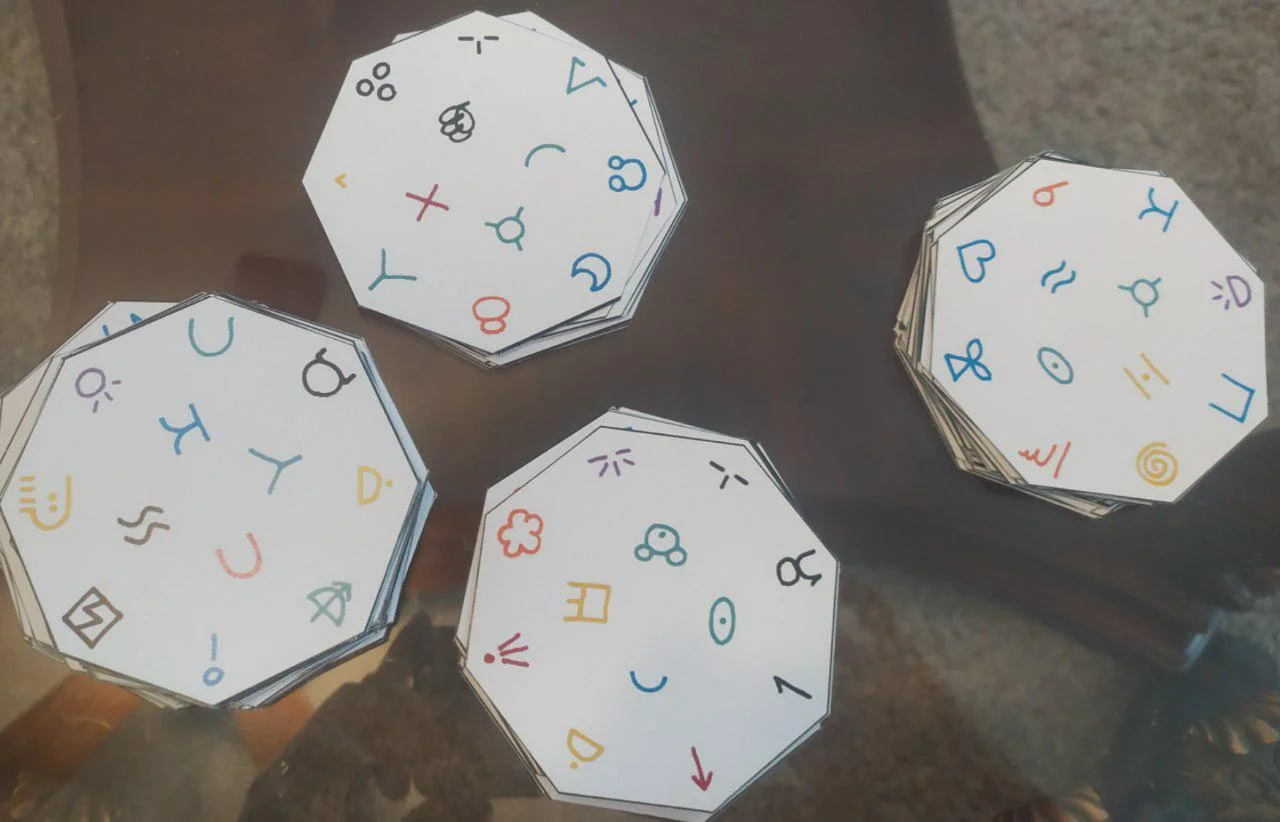
Simple recommended rules: shuffle the cards, give one face-down card to each player, and place the rest of the deck face up in the middle. Everyone flips their card at the same time. The first person to find the symbol shared by their card and the top deck card says the Toki Pona word out loud, or points at it if they do not know it yet, and takes the card. Whoever wins the most cards wins.
Spot It / Dobble is not just a clever pile of cards; it is a small piece of finite geometry. If you think of cards as lines and symbols as points, the rule “any two cards share exactly one symbol” becomes the projective-plane rule “any two lines meet in exactly one point.”
For a finite projective plane of order $n$, there are $n^2+n+1$ cards, $n^2+n+1$ symbols, and $n+1$ symbols per card. The standard construction works when $n$ is a prime power $n = p^k$, for $p$ prime and $k \in \mathbb{N}$, such as $n=7$ for the original game. The standard Spot It / Dobble used $n = 7$, giving $57$ possible cards and $8$ symbols per card (although $2$ cards are not printed). Musi Tu’s full generated system has $133$ possible cards and features $133$ symbols (core Toki Pona words and some extra ones), which fits order $11$: $11^2+11+1=133$, with $12$ symbols per card.
The code and source files are on GitHub. For more on the math, see Puzzlewocky’s Finite Projective Planes and the Math of Spot It or David Wakeham’s Generalising Spot It.